Publications

Selected publications and research outputs. Click READ MORE to view the full abstract.

Fracture Extraction from Smooth Rock Surfaces Using Depth Image Segmentation
RESEARCH PAPER

Fracture Extraction from Smooth Rock Surfaces Using Depth Image Segmentation

(Rock Mechanics and Rock Engineering (RMRE))
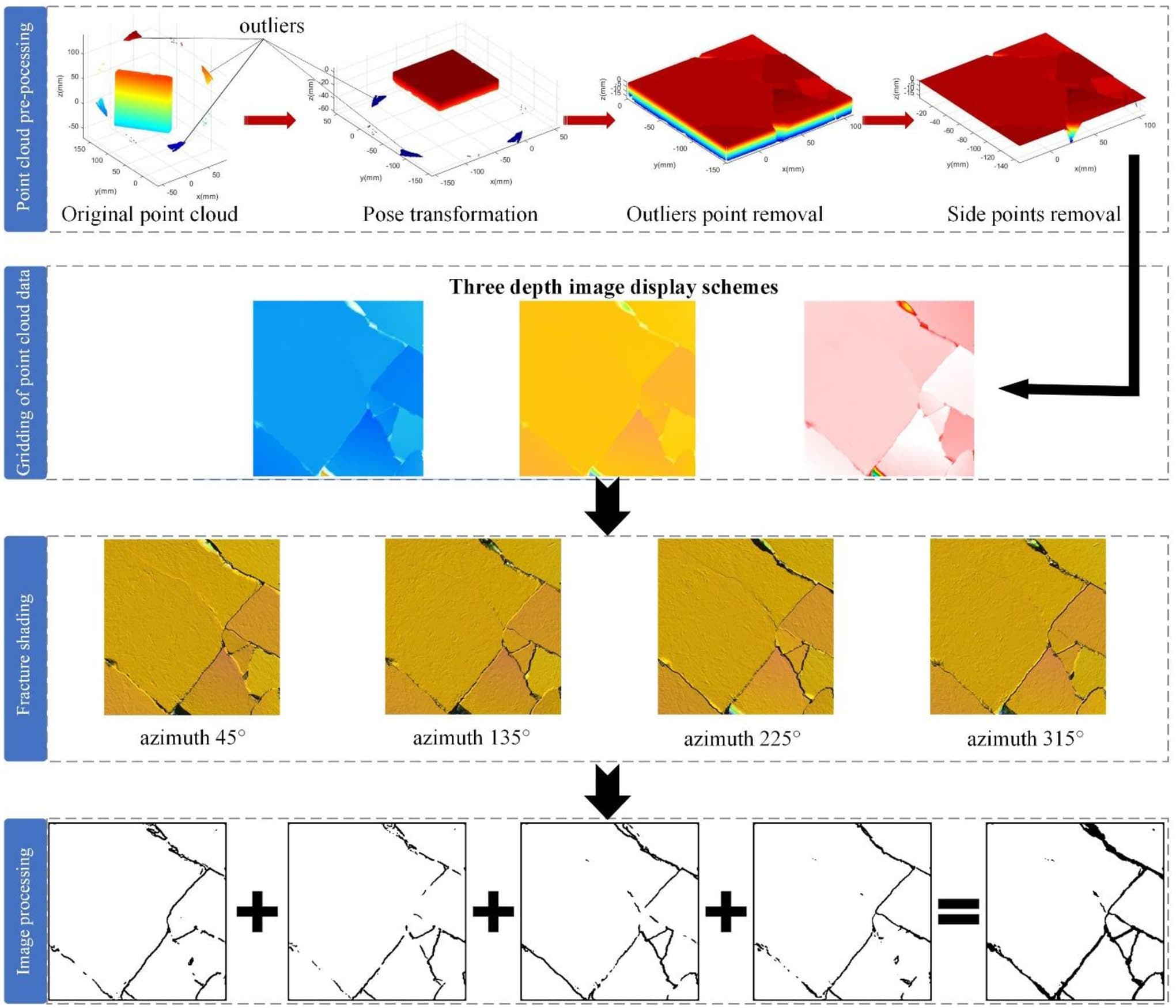
Due to the diversity of mineral particle features in rock, including sizes, shapes, arrangements, and structural connections, the color image of the rock sample surface at laboratory scale is quite complex. Thus, unacceptable misjudgement and information loss often occur when the traditional image processing algorithms are adopted. To improve the accuracy of fracture extraction, a method based on image processing algorithms is proposed in this paper to extract fractures from 3D point clouds. First, a high-precision original depth image is generated by gridding the rock surface point cloud data with the Kriging interpolation. The hill shading method is then applied to further clarify the fractures. Finally, the fractures are extracted from depth images and compared with color images. The results show that the integrity of the fracture skeleton is significantly improved and the error rate is reduced. In combination with color images, the physical fractures and other fracture-like features can be distinguished. The proposed method provides a new idea for extracting fractures in various destructive experiments on rocks, and may be developed for recognition of discontinuities at typical engineering scale.
From laboratory to field: normal map-aided multimodal instance segmentation for blasting fragmentation analysis
RESEARCH PAPER

From laboratory to field: normal map-aided multimodal instance segmentation for blasting fragmentation analysis

(Advanced Engineering Informatics)
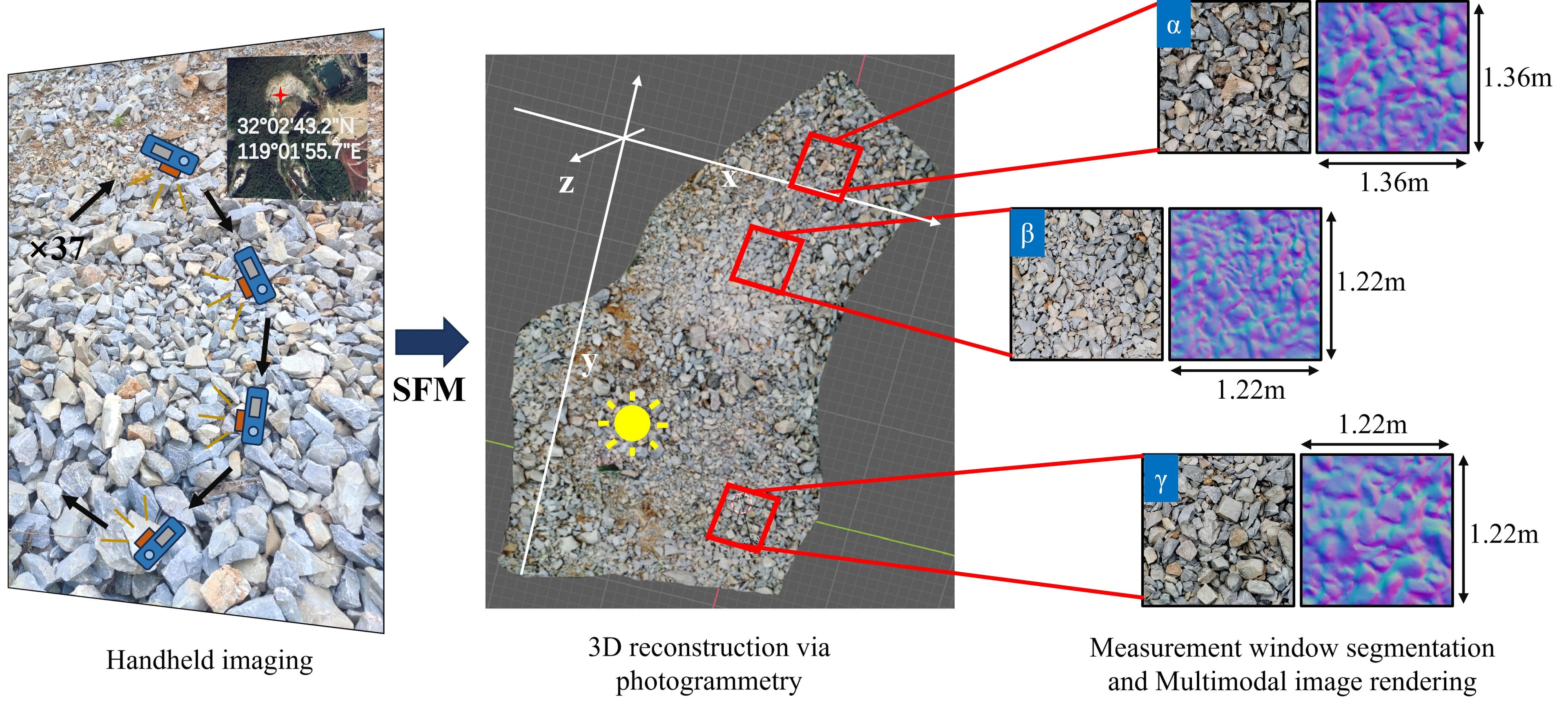
Particle size analysis of rock fragments plays a crucial role in mining engineering. However, traditional non-contact image-based methods typically rely solely on RGB images, which are highly sensitive to illumination changes, shadow interference, and fragment texture. This reliance limits the accuracy and generalization capability of conventional approaches and often necessitates retraining when applied across different scenes. To address these issues, this study introduces normal maps and provides a detailed analysis of their advantages in representing rock fragment features. Furthermore, we propose a multimodal instance segmentation framework named Adaptive Feature Recombination Network (AFRNet). AFRNet incorporates a modality effectiveness perception mechanism to adaptively guide the fusion process while suppressing interference from unreliable modalities. In addition, it employs a multi-scale attention fusion module to fully exploit and utilize the strength of each modality. This study systematically compares three fusion strategies—data-level, feature-level, and decision-level—and conducts experiments under various modality combinations. Experimental results demonstrate that incorporating normal maps significantly improves segmentation accuracy and enhances model robustness in degraded environments such as low illumination and shadow interference. Moreover, the model trained in a laboratory environment is directly transferred, without retraining, to a practical particle size analysis task at an actual mining site in Nanjing. The resulting particle size distribution curves exhibit a deviation of less than 10% compared with manually labeled results, validating the proposed method’s zero-cost transferability and engineering applicability.
Estimation of in-situ rock strength from borehole geophysical logs in Australian coal mine sites
RESEARCH PAPER

Estimation of in-situ rock strength from borehole geophysical logs in Australian coal mine sites

(International Journal of Coal Geology (269, 2023))
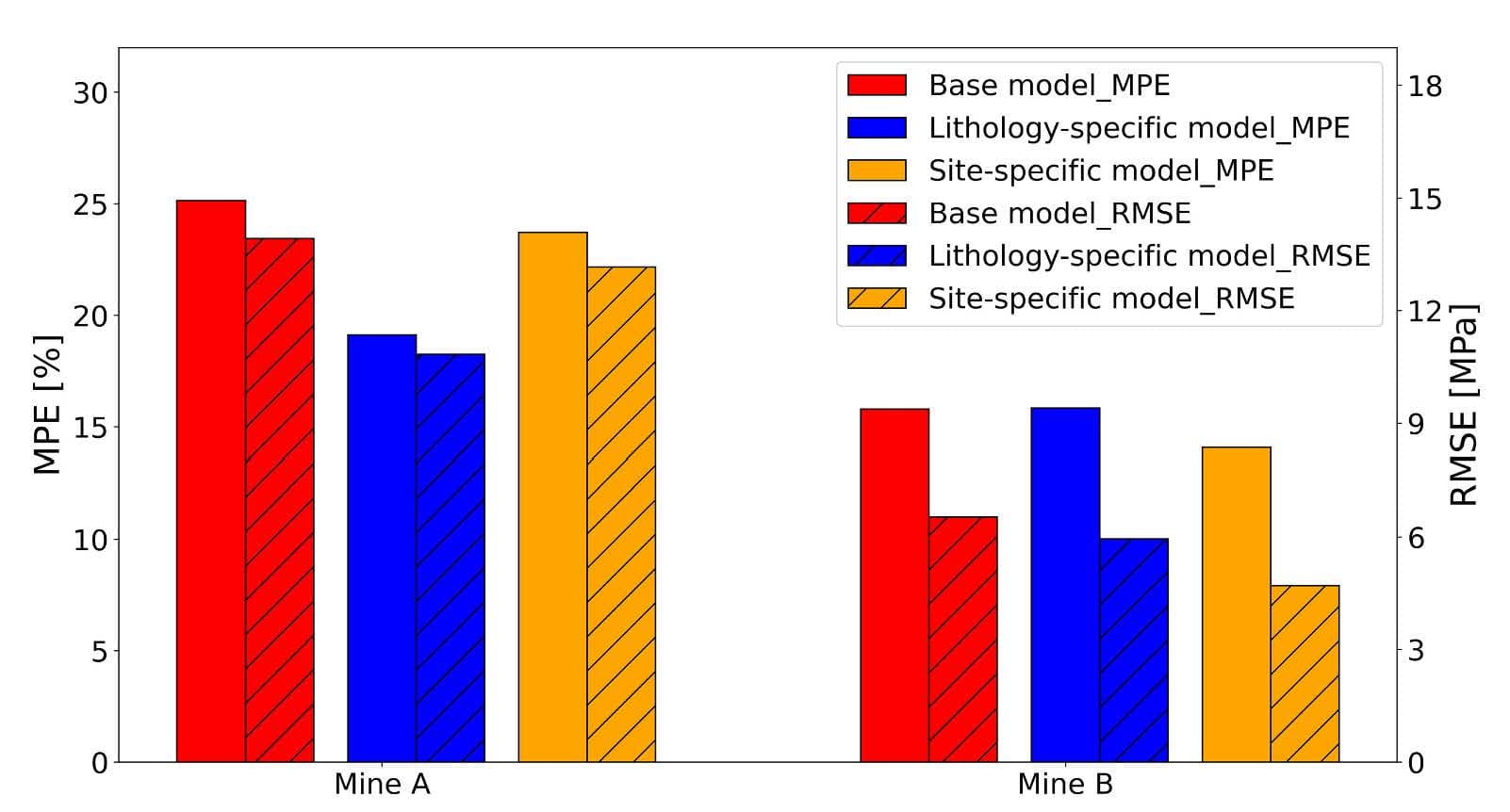
This study improves conventional empirical rock-strength estimation used in Australian coal mining by developing artificial neural network (ANN) models to predict uniaxial compressive strength (UCS) from borehole geophysical logs. A dataset of 274 laboratory UCS tests was paired with sonic, gamma, neutron, porosity logs, and density, and used to train a two-hidden-layer ANN with Levenberg–Marquardt learning. Compared with sonic–UCS fitting equations, the ANN reduces prediction errors substantially. Further lithology-specific and site-specific models show additional accuracy gains, highlighting the influence of lithology and local geological conditions on UCS estimation for downstream geotechnical analysis.
Estimation of in-situ horizontal stresses based on multiscale borehole breakout data via machine learning: model development, validation and application
RESEARCH PAPER

Estimation of in-situ horizontal stresses based on multiscale borehole breakout data via machine learning: model development, validation and application

(Geophysical Journal International)
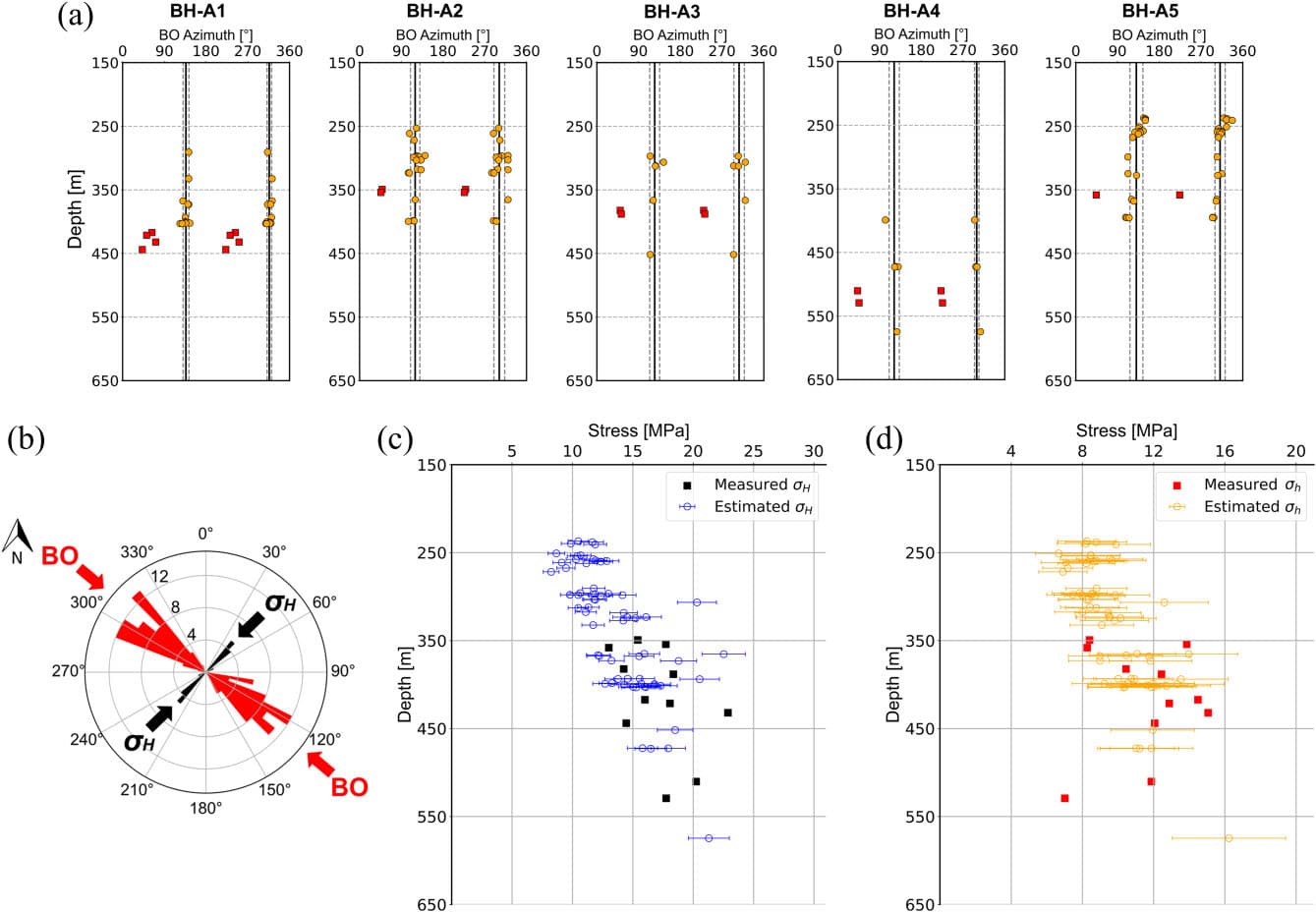
Borehole breakout (BO) has increasingly been utilized to estimate in-situ stress magnitudes given the importance of the stress field in subsurface activities and the limitations of conventional stress measurement techniques. In this study, a new backpropagation neural network model is developed to estimate both maximum and minimum horizontal stress magnitudes from multiscale BO data. A total of 150 experimental data points from pre-stressed true-triaxial laboratory tests and 44 field data from a mine site in Australia and the literature are collected and employed for model development and validation. Compared to previous studies, the collected data set is significantly enhanced in both quantity and quality. To address discrepancies in stress magnitudes between experimental and field data, the three principal stresses are normalized by borehole wall strength (BWS). Overall, the model achieves mean absolute percentage errors of below 8 per cent for the maximum horizontal stress and below 20 per cent for the minimum horizontal stress, significantly outperforming the previous model developed for this purpose. Furthermore, these error rates fall within the typical error range (10–20 per cent) of conventional stress measurement techniques, indicating the model’s sufficient accuracy for practical applications. Moreover, the effectiveness and generalizability of the model are verified using 166 additional BOs from two mine sites, which are independent of those used in model development. Continuous and detailed stress profiles are established based on these BOs, covering greater depth intervals than the stress measurements from the overcoring method. The results of this study demonstrate that the proposed model can provide reliable and accurate stress estimation, utilizing input parameters that can be readily obtained from borehole geophysical logs.